القاتل الصامت: لماذا "يهلوس" الذكاء الاصطناعي عندما يقرأ موقعك متعدد اللغات
 MultiLipi
•
Jan. 19, 2026
•
قراءة لمدة 10 دقائق
MultiLipi
•
Jan. 19, 2026
•
قراءة لمدة 10 دقائق
Imagine you have invested significant resources into perfectly localizing your website for a global audience. The content reads beautifully to native human speakers, yet behind the scenes, AI chatbots and search engines may be completely misinterpreting your value proposition. This is the “silent killer” of international expansion: when generative AI “hallucinates” making up facts or confident nonsense because it lost the necessary context during the translation process.
In the 2026 search landscape, this issue has marketing leaders on edge. Flawed multilingual content confuses systems like Google’s Search Generative Experience (SGE), Bing Chat, and ChatGPT. If the context isn’t crystal clear, these AI engines might misquote your pages, omit them from answers entirely, or even attribute your product features to a competitor. As John Mueller of Google has emphasized, effective localization must go beyond the "minimal bar" of translating words if you want global users and now AI to truly value your site. For a deeper look at the evolution of these strategies, visit MultiLipi - Latest Blogs.
The Global Anatomy of an AI Hallucination
To solve the problem of misinterpretation, we must first understand the mechanic of the error. An AI hallucination occurs when a Large Language Model (LLM) confidently generates false or misleading information as if it were factual. This isn't a rare technical glitch; recent benchmarks of 29 top LLMs found hallucination rates ranging from 15% to 52% in models like GPT-5 and Google Gemini. AI might sound sure of itself, but it doesn't truly "know" truth from fiction; it merely predicts what words or facts should come next based on statistical likelihood.
Unlike humans, AI doesn't read for inherent meaning. It is a sophisticated pattern-matching engine trained on billions of sentences to learn linguistic probabilities. When you feed it multilingual content, it sees a string of patterns rather than a conceptual reality. It has no built-in concept of the difference between "Turkey" the bird and "Turkey" the country without explicit, localized context. If your international text is ambiguous, the AI won't ask for clarification; it will simply invent a plausible-sounding interpretation. Because these responses are grammatically perfect, users often cannot distinguish between helpful facts and "plausible-sounding nonsense". To see if your site's technical health is already affecting its clarity, you can utilize the MultiLipi - Free SEO Audit Tool.
Context Collapse The Root of Linguistic Failure
The chief culprit behind these hallucinations is "context collapse". This refers to the loss of crucial meaning when language is translated or handled outside of its original cultural framework. Nuances that tell an AI which version of a word you mean get stripped away during the translation process. Basic translation tools often treat each sentence as an isolated string, ignoring the tone, cultural cues, or intent that give words their true meaning. The result is content that might look correct to a casual observer but lacks the metadata an AI needs to interpret it correctly.
Consider the English word "turkey." In a culinary context, it should translate to "pavo" in Spanish or "dinde" in French. If a basic plugin instead leaves it as "Turquía" or "Turquie" (the nation), an AI reading that version now thinks your content is about geopolitics rather than food. Beyond simple nouns, automated translations can accidentally reverse meaning by dropping nuances like "non" (not). We have seen cases where safety warnings were translated to say the exact opposite of the original message because a single negative was lost, leading an AI to confidently report false information to users. For brands looking to avoid such catastrophic errors, understanding MultiLipi - Cultural Nuance in SEO is the first step toward building a global "knowledge graph" that AI can trust.
High-Context vs. Low-Context Language Markets
To serve a truly global community, a Multilingual GEO strategy must account for the spectrum of high-context and low-context languages. While English is a relatively low-context language where meaning is explicitly stated in words, languages like Japanese, Arabic, and Hindi are high-context. In these markets, the meaning of a word is often dependent on social hierarchy, honorifics, and the relationship between the speaker and the listener.
If your translation strategy ignores these levels of cultural hierarchy, an AI model trained on that specific language may determine that your content is "unnatural" or "untrustworthy" compared to native sources. For instance, a Japanese-language AI engine might serve a user content from a native local site over your translated page if your honorifics are mismatched, even if your facts are identical. Furthermore, the "Same-Language Trap" complicates regional targeting. Google may simplify its index by choosing only one version of a page for a language, such as choosing a France-based page over a Belgian-French page, if the regional signals like currency and local imagery—are not sufficiently distinct. To evaluate the scale of your global translation needs and avoid these traps, start with the MultiLipi - Free Word Count Tool.
From SEO to GEO - The 2026 Strategy Shift
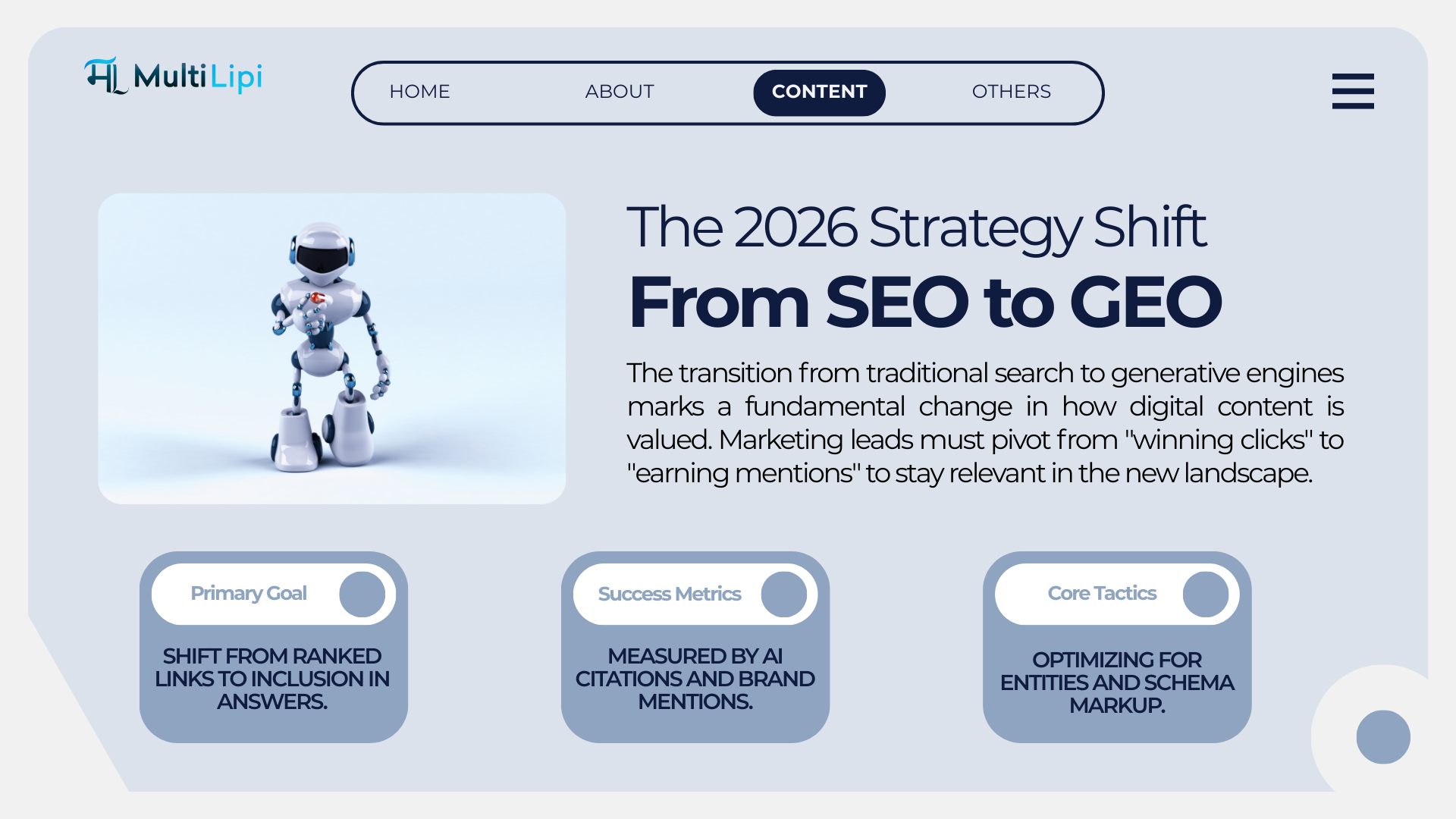
The transition from traditional search to generative engines marks a fundamental change in how digital content is valued. Understanding this shift is essential for any modern marketing lead:
- الهدف الأساسي: The objective of traditional SEO is to achieve ranked links and drive organic clicks to a specific website. In contrast, the primary goal of GEO is to secure inclusion and citations within AI-generated answers.
- مؤشرات النجاح: يقاس النجاح في عصر تحسين محركات البحث من خلال إجمالي حركة المرور العضوية وترتيب الكلمات المفتاحية. ومع ذلك، يتم قياس نجاح GEO من خلال تكرار الاستشهادات الذكاء الاصطناعي وحجم الإشارات إلى العلامة التجارية ضمن النتائج المركبة.
- التكتيكات الأساسية: تركز تكتيكات تحسين محركات البحث على الاستخدام الاستراتيجي للكلمات المفتاحية واكتساب الروابط الخلفية. يتطلب GEO تحولا نحو تحسين الكيانات، وتنفيذ ترميز مخططات تفصيلية، وإنشاء إشارات سلطة قوية.
- تفاعل المستخدم: يتبع نموذج تحسين محركات البحث نمط "البحث والنقر"، حيث يتنقل المستخدمون في قائمة الروابط. يسهل GEO نموذج "اسأل واستقبل"، حيث يوفر إجابة واحدة مركبة مباشرة للمستخدم.
- المشهد التنافسي: In SEO, you are competing against other web pages for visibility on a results page. In the world of GEO, your content must compete against the vast, integrated knowledge graph of the entire AI engine.
مثل [Forbes - The Future of AI Search] points out, brand authority is now the primary currency in the generative era. To stay ahead of these risks and see how you compare to existing market leaders, view MultiLipi - Alternatives and Comparisons.
The GEO Framework for Global Brands
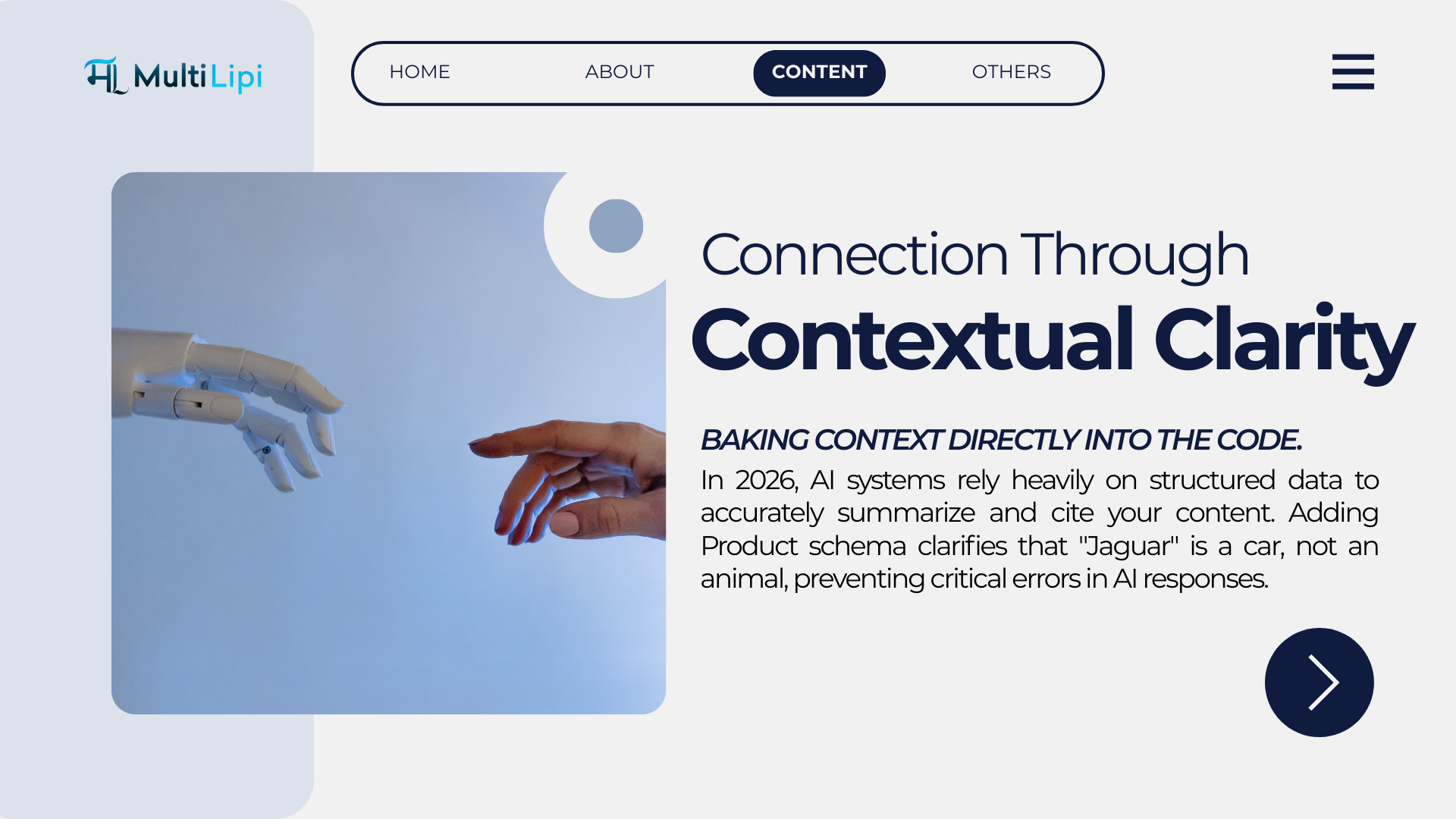
If context is the missing ingredient causing AI misreads, the solution is to bake context directly into your site’s code through Generative Engine Optimization (GEO). This is especially critical for multilingual sites where the risk of ambiguity is highest.
Implementing Structured Data for Disambiguation
Schema markup is a code that explicitly tells search engines and AI what your page is about beyond the raw text. For example, if you have a page about a product named "Jaguar," adding Product schema clarifies to the AI that you are not talking about an animal. Schema eliminates ambiguity, delivering facts directly rather than forcing the AI to guess. In 2026, AI systems rely heavily on structured data to accurately summarize and cite your content. For a full technical breakdown, see the MultiLipi - Multilingual Schema Implementation Guide.
Hreflang Tags and Site Integrity
A foundational aspect of multilingual SEO is the hreflang tag. Proper hreflang implementation ensures Google and other engines serve the right language version to the right audience, which prevents an AI from quoting a German page to a Japanese user. Each translated page should have a clean URL and hreflang references that include all language versions, including itself. This avoids AI and search engine confusion over duplicate content. Check your own site with the MultiLipi - Ultimate Hreflang Tag Guide.
Real-World Success MultiLipi Case Studies
The move from traditional SEO to GEO has already yielded massive results for companies willing to prioritize context.
Prior to using MultiLipi, فندق كونتينتيل , a boutique hotel in Italy, operated a single-language Italian site with limited reach and high bounce rates for international visitors. After implementing MultiLipi’s automated GEO and Hreflang strategy across 8 languages, the hotel achieved a زيادة بنسبة 120٪ في حركة المرور العضوية from target markets like Germany and France. Furthermore, the hotel experienced a زيادة بنسبة 35٪ في الحجوزات الدولية المباشرة as the site became a citable, trusted source for local language AI systems.
These results prove that when your pages are optimized for context, AI rewards you with helpful answers that feature your brand as the authority. For more detailed results, explore our MultiLipi - Multilingual Case Studies.
الخلاصة: توقف عن التخمين، وابدأ في النمو
Accuracy in multilingual content is no longer just a linguistic preference; it is a strategic requirement for surviving in the era of AI-driven search. By treating your translated content as first-class content and embracing GEO from schema markup to human-in-the-loop localization you can turn AI from a liability into an asset.
When your international pages are optimized for context, AI will reward you with visibility in the new AI-centric search results. The future of search is generative; it’s time to optimize for answers, not just links. Address your context collapse now, and position your brand as a global authority.
ابدأ رحلتك متعددة اللغات اليوم
Take the first step toward global visibility and AI-ready content with MultiLipi's suite of professional tools.
- MultiLipi - Free Word Count Tool: Calculate your translation volume accurately.
- MultiLipi - Free SEO Audit Tool: Detects gaps in your current multilingual SEO strategy.
- MultiLipi - Free Hreflang tag checker Tool: scans your page and identify existing tags, and validate them with better suggestions
- MultiLipi - Free LLMs.txt file Tool: Scans your webpage to extract relevant information and creating a structures LLMs.txt file
سجل أو سجل الدخول إلى MultiLipi - Dashboard Login to begin your multilingual expansion. To proactively detect potential hallucinations on your site, join the beta for our upcoming MultiLipi - AI Confusion Diagnostic.
التعليقات